


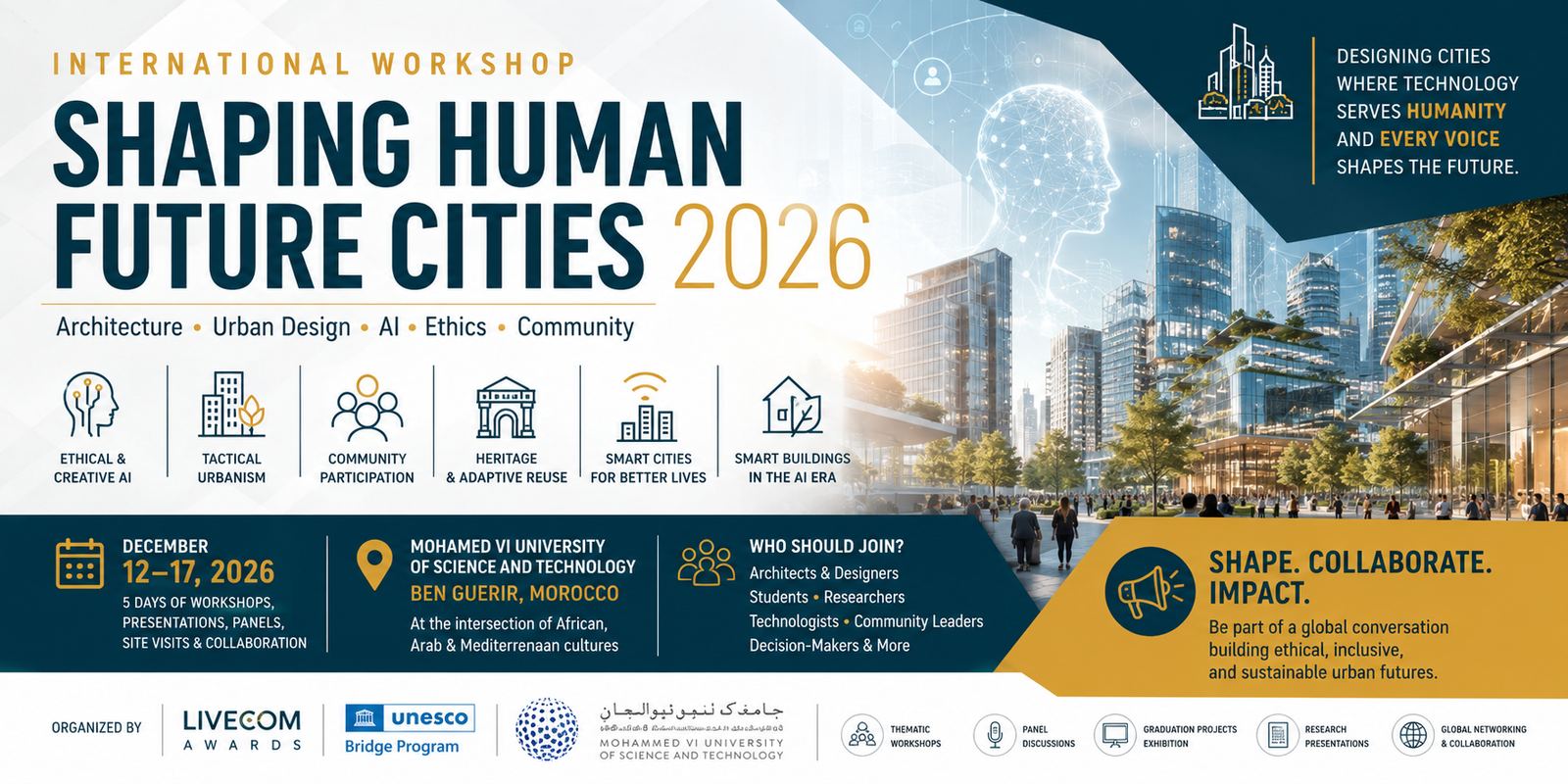
The Vision
We believe that architecture and urban design are acts of imagination and responsibility. The futures we build matter. They can amplify community voice or erase it. They can perpetuate inequality or enable justice. They can extract or regenerate.
This forum is built on five founding commitments:
- Technology should serve humanity, not replace it.
- Smart cities are cities where every person is heard and every neighborhood thrives.
- AI is a tool for creative expression and cultural memory—not surveillance or control.
- Architecture and urban design are acts of justice. They can amplify community voice or erase it.
- Innovation happens at the intersection of design, ethics, tradition, and daring experimentation.
Why Now?
Cities are at an inflection point. The tools we use to design and manage urban space—particularly artificial intelligence—are advancing faster than our ability to ask ethical, creative, and humane questions about their use. Meanwhile, inequality deepens, climate urgency intensifies, and young people are demanding a different kind of city.
The future of cities is being decided now. This is our moment to be intentional, creative, and inclusive.
When
Five days of intensive workshops, presentations, panel discussions, site visits, and collaborative projects designed for active participation and peer-to-peer learning. The entire event will be covered across all social media platforms.
Where
Mohamed VI University of Science and Technology
Ben Guerir, Morocco
State-of-the-art facilities including lecture halls, workshop spaces, collaboration areas, and accommodation. Morocco’s position at the intersection of African, Arab, and Mediterranean cultures makes it ideal for a global forum on sustainable urbanism. Participants will have opportunities to tour innovative urban projects in Casablanca, Marrakech, and surrounding regions.
Who Should Participate?
Architects & Designers
Share experimental work and visions with peers and emerging practitioners.
Students
Engage with leading thinkers. Challenge conventional thinking. Discover the architect or designer you want to become.
University Groups & Researchers
Lead international workshops. Present and publish research. Build collaborative networks.
Academics & Researchers
Bring interdisciplinary perspectives. Collaborate across silos. Publish in proceedings and peer-reviewed journals.
Technologists & Smart Cities Experts
Help design communities ask better questions. Make smart cities more humane.
Community Organizers & Decision-Makers
Your voices are essential. Ensure cities work for everyone.
How to Participate
Option 1: Lead a Thematic Workshop
University departments and research groups propose and facilitate workshops. Workshops must engage participants from two to three or more other universities or countries and include practitioners, academics, and decision-makers.
Your workshop will:
- Align with one of the six workshop themes.
- Combine presentations, discussion, and hands-on collaborative work lasting 3–6 hours.
- Be documented for publication in the forum proceedings.
Option 2: Submit Graduation Projects for Exhibition
Community-based projects solving real urban problems aligned with the workshop themes are invited for submission. Projects will be displayed onsite on standard exhibition boards, with the final board size to be confirmed.
This is a unique opportunity to showcase student work in an international forum and connect with practitioners, academics, and collaborators.
Option 3: Present Research
Submit research abstracts of 300–500 words. Optional journal publication opportunities will be available, with author fee guidance provided.
Option 4: General Participation
Attend workshops, engage in discussions, and participate in panel dialogues.
Registration
Early Bird Registration
Register early and enjoy special early-bird rates while building your network.
Regular Registration
Standard registration rates apply. Space is limited, so register early.
What to Bring & What We Provide
We Provide
- Workshop materials including flip charts, pens, pencils, notepads, and other supplies for hands-on collaboration.
- Refreshments and meals during the forum.
- Access to all workshop spaces, lecture halls, and collaboration areas.
Please Bring
- Your own laptop, which is essential for workshops and collaborative work.
- Any presentation materials or portfolios you wish to share.
A Forum for Connection
SHFC 2026 is fundamentally about building community and seeding collaboration. Beyond workshops and presentations, this is a rare opportunity to:
- Connect with researchers, practitioners, and innovators from universities and institutions across the globe.
- Exchange ideas across disciplines, geographies, and perspectives.
- Explore opportunities for academic collaboration—joint research, student exchanges, and shared publications.
- Discover professional partnerships and practice-based collaborations.
- Build long-term research networks that extend well beyond December.
The entire event will be documented and shared across social media, giving your work and ideas global visibility.
What We’re Exploring: Six Interconnected Themes
1. Ethical & Creative AI in Design & the Arts
How do we use AI responsibly? Generative design, algorithmic creativity, and human judgment in the age of automation.
2. Tactical Urbanism & Simple Urban Interventions
Small acts, big impact. Temporary installations, community-led projects, and low-cost urban tactics.
3. Public & Community Participation
Co-designing cities with residents. Including marginalized voices in shaping urban futures.
4. Adaptive Reuse of Historic Buildings in the AI Era
Heritage meets innovation. Preserving cultural memory while building resilience.
5. Smart Cities for Better Lives
Beyond sensors and data. Smart cities that prioritize health, equity, accessibility, and joy.
6. Smart Buildings in the Era of AI
Energy-efficient, adaptive, humane buildings. Spaces that respond to human need.
Forum Components & Activities
Thematic Workshops
Intensive, participatory sessions combining presentations, hands-on projects, and critical dialogue.
Panel Discussions
Moderated conversations with architects, planners, technologists, ethicists, organizers, and policymakers.
Graduation Projects Exhibition
An onsite showcase of community-based design solutions on standard exhibition boards and a platform for student work to reach an international audience.
Research Presentations
Academics and researchers present work addressing critical questions about AI, design, urbanism, justice, and sustainability.
What You Get
- Forum Proceedings documenting all workshops and projects.
- Online Exhibition of Graduation Projects with global reach.
- Curated Research Papers in peer-reviewed journals, with optional publication and applicable author fees.
- A Design Manifesto articulating shared principles for ethical and equitable urban futures.
- A Research Network connecting participants for ongoing academic and professional collaboration.
- A Digital Archive of all workshops, presentations, and collaborative work.
- Official Certificates issued jointly by LiveCom Awards, UNESCO Bridge Program, and Mohamed VI University.
- Global visibility through social media coverage of the entire forum.
Learn More & Submit
Submit all proposals, projects, research abstracts, and registrations by:
October 1, 2026
Submission Website or Email:
[SYMPOSIUM WEBSITE/EMAIL]
Questions?
[CONTACT EMAIL]
Join us in Morocco this December.
About Prof. Ahmed Radwan
Prof. Dr. Ahmed Hosney Radwan is Dean of the Faculty of Arts & Design at Elsewedy University of Technology and Chair of the Community Service & Environmental Development Council.
As Principal of AHR Architecture Design Studio and founder of the AI and Architecture Research Group, established in 2022, he combines deep expertise in design practice with rigorous research on how artificial intelligence, cultural heritage, and community participation can reshape urban futures.
With adjunct positions at the American University in Cairo and Capital University, and extensive experience across the MENA region and East Africa, Prof. Radwan brings both deep regional grounding and an international perspective. His work spans architecture, urban design, design education, and research on the intersection of technology, culture, and community engagement.
A Registered Architecture Consultant since 2011, an AIA International Associate since 2015, and a member of the Egyptian Syndicate of Engineers since 1993, Prof. Radwan is committed to designing cities where technology serves humanity, heritage is preserved and celebrated, and every voice shapes the future.